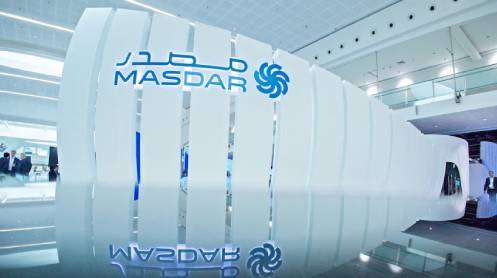
ABU DHABI: The 18th World Future Energy Summit (WFES) opened in Abu Dhabi on Monday with strong signals of accelerating global investment in clean energy, as Masdar projected a $11 trillion global green hydrogen opportunity by 2040 and the European Union announced a major expansion of its energy funding programme.
Held under Abu Dhabi Sustainability Week and hosted by Masdar, the summit runs until January 15 at the ADNEC Centre, bringing together global policymakers, investors and industry leaders to advance renewable energy and climate solutions.
A key announcement on the opening day came from Ditte Jørgensen, Director General for Energy at the European Commission, who confirmed that the EU plans to increase its Connecting Europe Facility (CEF) for Energy five-fold to €30 billion (around Dh120 billion). The move positions the Gulf region as a strategic partner in Europe’s energy transition and the development of cross-border energy networks.
The summit underscored Abu Dhabi’s growing role as a global hub for green energy deal-making, with rising financial linkages between the UAE, Europe and Australia. This momentum follows recent high-profile investments in the capital, including the launch of a major data centre, highlighting broader international interest in local infrastructure.
Key figures shared during the opening session included:
- €30 billion (Dh120 billion): Target size of the EU’s expanded CEF Energy fund
- €328 billion (Dh1.3 trillion): Current value of mutual investments between the UAE and the EU
- $11 trillion (Dh40 trillion): Estimated global investment required for green hydrogen by 2040, according to Masdar
Lucie Berger, EU Ambassador to the UAE, said the Emirates has emerged as the EU’s leading investment partner in the region, adding that future cooperation would increasingly focus on hydrogen and clean technologies, where the UAE is rapidly expanding capacity.
Beyond Europe, WFES also highlighted the emergence of a new UAE–Australia green energy corridor following the ratification of the Comprehensive Economic Partnership Agreement (CEPA) in November 2025. Trevor Ducharme, President of Global CMX, described the agreement as a “catalyst to unlock billions of dollars in renewable energy deals,” particularly in solar and hydrogen projects linking Australian resources with UAE logistics and finance.
Masdar’s Chief Hydrogen Officer, Mohammad Abdelqader El-Ramahi, said the hydrogen sector has moved from concept to large-scale infrastructure, stressing that meeting global demand would require massive capital mobilisation over the next two decades.
At the national level, the Abu Dhabi Department of Energy noted that solar energy has evolved from an emerging option to core infrastructure. Ahmed Al Falasi, Executive Director for Energy Efficiency, said the focus has shifted from generation to reliability.
“Solar provides scale and cost efficiency, storage provides flexibility, and nuclear provides clean, stable baseload power,” Al Falasi said. “Together, these technologies ensure energy security while supporting economic growth.”
On the sidelines, climate experts stressed the need for region-specific urban planning in the Gulf. Marina Antonopoulou of Emirates Nature WWF said cities in hot climates cannot simply replicate Western models, pointing to Abu Dhabi’s mangrove restoration projects as an example of how local ecosystems can function as effective green infrastructure, enhancing resilience and biodiversity.
With hydrogen, solar, storage and nuclear high on the agenda, WFES 2026 signalled a decisive shift from planning to execution, reinforcing Abu Dhabi’s position at the centre of the global clean energy transition.